
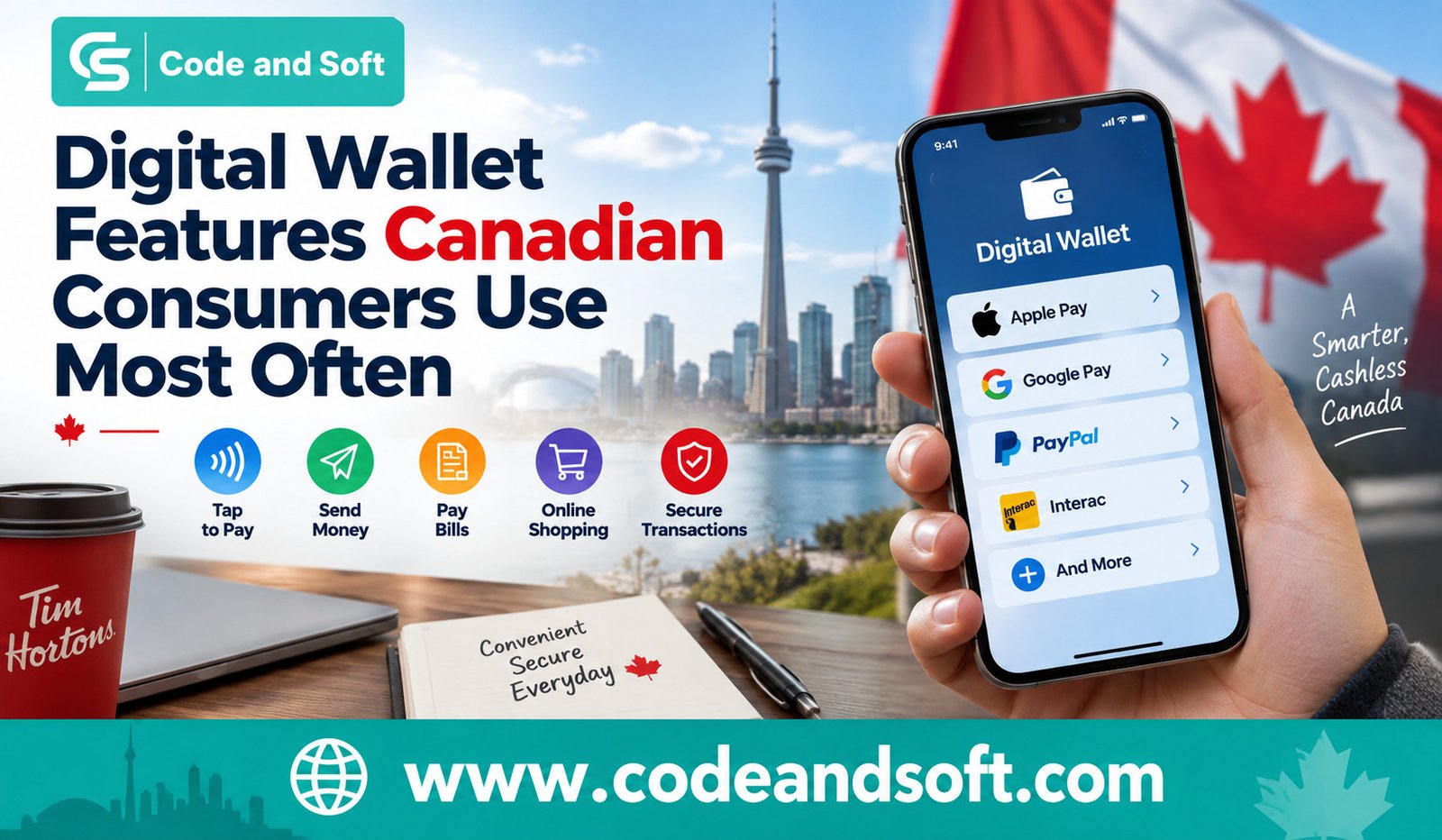

If you still think of a wallet as something you carry in your pocket, you are already looking at payments the old-fashioned way. Across Canada, your smartphone can now hold many of the things you once needed a physical wallet for: debit and credit cards, loyalty cards, tickets, passes and, depending on the service, other digital credentials.
The growth of Digital Wallets Apps Use In Canada reflects a wider shift toward convenient digital payments. Payments Canada reported that contactless payments represented 58% of transactions in 2024, while digital payments accounted for 86% of total payment volume.
But what features do you actually use most often? For many Canadian consumers, it is not complicated financial technology. It is the simple ability to tap your phone at checkout, store several cards in one place, pay online faster and keep everyday passes close at hand.
Here is a closer look at the digital wallet features that are becoming part of everyday life in Canada.
1. Tap-to-Pay Is Still the Main Attraction
The feature you are most likely to appreciate is also one of the simplest: tap-to-pay.
Instead of pulling out your physical credit or debit card, you can unlock your phone, authenticate the transaction and hold the device near a compatible payment terminal. Canadian government guidance explains that mobile contactless payments use near-field communication, or NFC, to communicate with payment terminals.
That makes digital wallets particularly useful when you are buying coffee, picking up groceries, paying for lunch or making a quick purchase while travelling.
For you, the appeal is obvious. You do not have to search through your bag for a card, and you can leave your physical wallet at home when you want to travel light.
2. Apple Wallet Keeps Everyday Cards Close
If you use an iPhone, Apple Wallet is one of the most familiar choices.
Apple Wallet allows you to keep eligible credit and debit cards on your device and use Apple Pay for purchases. You can authenticate payments with features such as Face ID or Touch ID, depending on your device.
For Canadian consumers, Apple Wallet is especially useful because Interac Debit can be added to supported digital wallets, allowing you to use your eligible debit card for everyday purchases.
You can also use your wallet beyond traditional shopping. Depending on the cards and services you use, digital wallets can bring together loyalty cards, tickets and other passes.
The biggest advantage is convenience: once your cards are set up, paying can become almost automatic.
3. Google Wallet Makes Android Payments Simple
If you use an Android phone, Google Wallet offers a similar experience.
You can add supported payment cards and use your phone for contactless purchases wherever Google Pay is accepted. Google notes that contactless payments require an NFC-enabled Android phone, while the availability of particular cards depends on the financial institution that issued them.
For you, this can make everyday payments much quicker. Rather than entering card details repeatedly or carrying several physical cards, you can select the payment method stored in your wallet.
Google Wallet can also be useful when you are shopping online or inside participating apps, where digital payment options can reduce the number of checkout steps.
4. Samsung Wallet Goes Beyond Payments
If you own a Samsung Galaxy device, Samsung Wallet combines payment features with a broader digital storage system.
Samsung describes Wallet as a place where you can keep credit cards, tickets, boarding passes, digital keys and other essentials. Samsung Pay is now integrated into Samsung Wallet as its payment component.
That means you are not simply replacing your bank card with your phone. You can potentially replace several pieces of your everyday wallet.
The quick-access design can also be useful when you are in a hurry. You can open Samsung Wallet with a swipe, tap or supported device shortcut and authenticate your payment using a PIN or biometric information.
5. PayPal Remains Important for Online Shopping
While Apple Wallet, Google Wallet and Samsung Wallet are closely connected with your smartphone and contactless payments, PayPal plays a slightly different role.
You are more likely to encounter PayPal when shopping online, using an app or checking out with a merchant that supports PayPal.
PayPal’s Canadian service allows you to pay, send and receive money through its app, while eligible purchases can also have access to PayPal Purchase Protection.
PayPal can also work with Google Pay in supported situations, including in-store purchases, apps and the Chrome mobile browser.
For you, this means you can have another payment option without repeatedly entering your full financial information at different online stores.
6. Storing Debit and Credit Cards
One of the most practical features of Digital Wallets Apps Use In Canada is the ability to store multiple payment cards.
You might have a credit card for rewards, a debit card for everyday spending and another card for specific purchases. Instead of carrying all of them, you can store supported cards digitally.
The Financial Consumer Agency of Canada explains that mobile wallets can store credit, debit and prepaid card information, as well as loyalty cards.
You can then choose which card you want to use at checkout.
For budget-conscious consumers, having your debit card available can be particularly useful. Interac says eligible Interac Debit cards can be added to Apple Pay, Google Pay or Samsung Pay and used for purchases where accepted.
7. Faster Online and In-App Checkout
Digital wallets are not only about standing at a physical checkout.
When you shop online from your phone, entering your card number, expiry date and other information can become tedious. A supported digital wallet can simplify that process by allowing you to select an available payment method and authenticate the transaction.
Interac says eligible debit cards can be used through digital wallets for participating online and in-app purchases.
That can be particularly helpful when you are ordering food, buying tickets, shopping for clothing or making a purchase through an app.
The less information you have to manually type, the quicker the checkout can feel.
8. Loyalty Cards and Everyday Passes
A digital wallet can also help you reduce the number of cards and pieces of paper you carry.
Depending on the wallet and supported services, you may be able to keep loyalty cards, tickets, boarding passes and other digital passes on your phone.
This is where wallets start to feel less like payment apps and more like digital versions of your everyday wallet.
Imagine going to the airport without searching through your bag for a printed boarding pass, or visiting a store without carrying a collection of loyalty cards. Having those items available on your phone can make everyday errands more streamlined.
9. Security Features Give You Extra Protection
Convenience is important, but you also want to know that your payment information is protected.
Modern digital wallets use authentication methods such as fingerprints, facial recognition, PINs or device passcodes. Interac also highlights tokenization, authentication and encryption as security features associated with eligible Interac Debit payments through digital wallets.
Tokenization is particularly useful because the actual card information does not simply have to be exposed during every transaction.
Of course, you should still protect your phone with a strong passcode and avoid sharing authentication details. A digital wallet is only as secure as the device and account practices surrounding it.
10. Public Transit and Everyday Travel
Another useful development is the ability to use digital wallets for certain transit payments.
Interac notes that eligible debit cards in digital wallets can be used for adult fares on participating transit systems.
For you, that can turn your smartphone into something you use not just at shops and restaurants, but while travelling around your city.
The same basic idea applies when you are travelling more broadly: keeping payment cards, tickets and passes together can reduce the number of physical items you need to manage.
11. Other Digital Wallet Options Canadians Are Exploring
The Canadian wallet landscape is not limited to the four familiar names.
Depending on your bank, device and shopping habits, you may encounter services connected with financial institutions, store-specific payment systems, prepaid cards and other payment apps.
The Bank of Canada’s research found that Apple, Google or Samsung Pay accounted for the vast majority of payment-app use among mobile payment app users in its study, with Apple Pay leading that group.
Meanwhile, the broader Canadian market continues to evolve. Recent reporting based on the Global Payments Report found that digital wallets represented 32% of Canadian e-commerce transaction value in 2025.
That suggests your digital wallet is becoming increasingly relevant not just at physical checkout counters, but online too.
What Makes Digital Wallets So Useful in Canada?
Ultimately, you probably do not choose a digital wallet because you want more technology in your life. You choose it because it removes small inconveniences.
You can tap your phone instead of taking out a card. You can store several payment methods in one place. You can check out online without typing card details repeatedly. You can keep loyalty cards, tickets and passes with you. And you can use security features such as biometric authentication to approve payments.
For Canadian consumers, the most useful digital wallet is therefore the one that fits naturally into the way you already live.
If you use an iPhone, Apple Wallet may become your everyday payment companion. If you use Android, Google Wallet offers a similarly straightforward experience. Samsung users can combine payments with passes and digital keys through Samsung Wallet, while PayPal remains a strong option for online shopping and digital payments.
The real story behind Digital Wallets Apps Use In Canada is not that physical wallets are disappearing overnight. It is that your smartphone is gradually taking over many of the wallet’s most useful jobs.
And once you get used to paying with a tap, storing your cards digitally and checking out with fewer steps, going back to a pocket full of plastic can start to feel surprisingly inconvenient.