

Introduction
In today’s competitive business environment, making quick and accurate decisions has become essential for success. Companies generate enormous amounts of data from sales, customers, marketing campaigns, financial activities, operations, and other business processes. However, collecting data is not enough. Organizations need effective tools to analyze this information and convert it into meaningful insights.
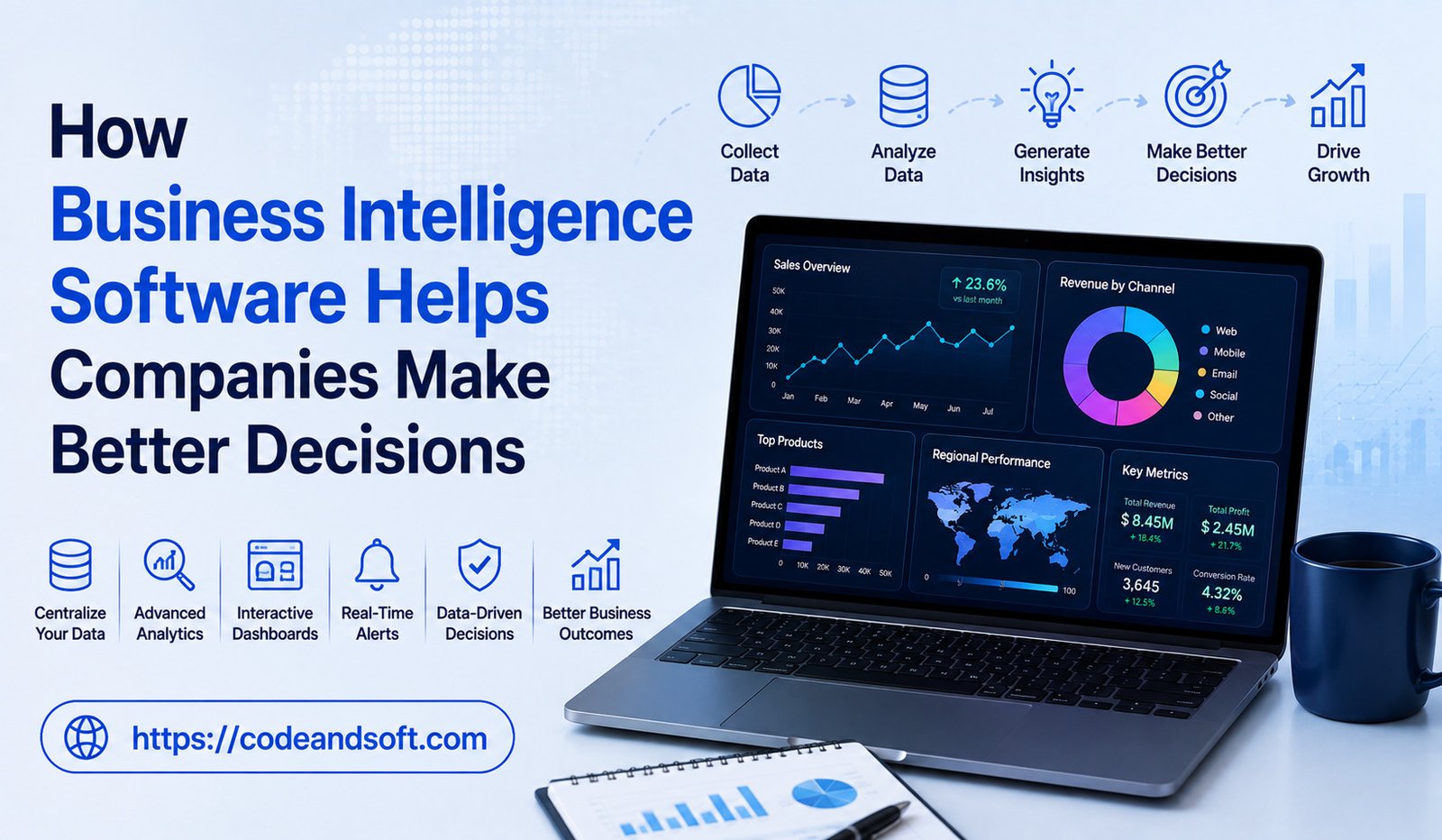
Business Intelligence (BI) software helps companies transform raw data into valuable information that supports smarter decision-making. These platforms collect data from multiple sources, analyze trends, create visual reports, and provide actionable insights that help leaders make informed choices.
Earlier, businesses depended heavily on spreadsheets and manual reports to understand performance. These methods were often time-consuming and prone to errors. Modern BI software uses automation, artificial intelligence, data visualization, and real-time analytics to provide businesses with a clearer understanding of their operations.
From improving customer experiences to optimizing financial performance, business intelligence software plays an important role in helping organizations make better decisions and achieve long-term growth.
What Is Business Intelligence Software?
Business Intelligence software is a technology solution that helps businesses collect, process, analyze, and visualize data. It allows organizations to understand past performance, monitor current activities, and predict future opportunities.
BI platforms combine data from different sources, including:
- Customer relationship management (CRM) systems
- Accounting software
- Sales platforms
- Marketing tools
- Enterprise resource planning (ERP) systems
- Cloud databases
The software converts complex information into easy-to-understand dashboards, charts, reports, and analytics.
For example, a retail company can use BI software to analyze customer buying patterns, identify best-selling products, track inventory levels, and predict future demand.
Why Business Intelligence Software Is Important for Decision-Making
Businesses make hundreds of decisions every day, from pricing strategies and marketing investments to operational improvements and financial planning. Without accurate information, these decisions may rely on assumptions rather than facts.
Business intelligence software improves decision-making by providing:
- Real-time data access
- Accurate business insights
- Performance tracking
- Predictive analytics
- Automated reporting
By using data-driven insights, companies can reduce risks and identify new opportunities.
Ways Business Intelligence Software Helps Companies Make Better Decisions
1. Provides Real-Time Business Insights
One of the biggest advantages of BI software is access to real-time information. Traditional reporting methods often require employees to collect and analyze data manually, which can delay important decisions.
BI platforms automatically update dashboards and reports as new data becomes available.
Businesses can monitor:
- Sales performance
- Revenue changes
- Customer activity
- Inventory levels
- Operational efficiency
For example, a company can immediately identify a sudden decline in sales and take corrective action instead of waiting for monthly reports.
Real-time insights help businesses respond quickly to changing market conditions.
2. Improves Data Accuracy
Incorrect information can lead to poor business decisions. Manual data collection and spreadsheet-based reporting often create errors due to duplicate entries, outdated information, or calculation mistakes.
Business intelligence software automatically collects and organizes data from connected systems, improving accuracy.
Accurate data helps businesses:
- Understand actual performance
- Identify problems quickly
- Create reliable forecasts
- Make confident decisions
With trustworthy information, leaders can develop better strategies.
3. Helps Identify Business Trends
Understanding market trends is important for long-term success. BI software analyzes historical and current data to identify patterns and changes.
Companies can discover:
- Customer preferences
- Seasonal sales trends
- Market opportunities
- Product performance
- Industry changes
For example, an e-commerce company can analyze customer purchase history to determine which products are becoming more popular.
These insights help businesses adjust their strategies before competitors.
4. Supports Data-Driven Decision-Making
Many businesses previously relied on experience and intuition when making decisions. While experience remains valuable, data provides stronger evidence for strategic planning.
BI software provides measurable insights that help companies evaluate different options.
Businesses can use data to make decisions about:
- Product development
- Marketing campaigns
- Pricing strategies
- Hiring plans
- Investments
Data-driven decision-making reduces uncertainty and improves business outcomes.
5. Enhances Customer Understanding
Understanding customers is essential for business growth. BI software helps companies analyze customer behavior, preferences, and interactions.
Businesses can study:
- Buying patterns
- Customer demographics
- Feedback trends
- Website activity
- Customer retention rates
These insights allow companies to create better products, improve services, and provide personalized experiences.
For example, a company can identify why customers are leaving and develop strategies to improve retention.
6. Improves Financial Planning
Financial decisions require accurate information about revenue, expenses, and profitability. Business intelligence software helps organizations analyze financial performance in detail.
Companies can track:
- Revenue growth
- Operating costs
- Profit margins
- Cash flow
- Budget performance
Financial dashboards help managers understand where money is being spent and identify opportunities to reduce unnecessary costs.
Better financial visibility leads to smarter investment decisions.
7. Optimizes Sales Performance
Sales teams rely on accurate information to improve performance. BI software provides insights into sales activities, customer behavior, and revenue trends.
Businesses can analyze:
- Sales targets
- Team performance
- Conversion rates
- Customer acquisition costs
- Product demand
Sales managers can identify successful strategies and improve areas where performance is weak.
8. Improves Marketing Decisions
Marketing campaigns require significant investment, so companies need to understand what strategies are working.
BI tools help marketers analyze campaign performance and customer engagement.
Businesses can measure:
- Advertising results
- Website traffic
- Customer responses
- Marketing expenses
- Return on investment (ROI)
These insights help companies create more effective marketing strategies.
9. Helps Predict Future Outcomes
Modern BI software uses artificial intelligence and machine learning to provide predictive analytics.
Predictive analytics helps businesses forecast:
- Future sales
- Customer demand
- Market trends
- Financial performance
- Potential risks
For example, a manufacturing company can predict product demand and adjust production levels accordingly.
Forecasting helps businesses prepare for future challenges and opportunities.
10. Improves Operational Efficiency
Business intelligence software helps companies identify inefficient processes and improve operations.
Organizations can analyze:
- Production performance
- Supply chain activities
- Employee productivity
- Resource usage
By identifying bottlenecks, businesses can reduce costs and improve efficiency.
Key Features of Business Intelligence Software
Data Visualization
BI platforms convert complex data into charts, graphs, and dashboards that make information easier to understand.
Visual reports help managers quickly identify important trends.
Automated Reporting
Businesses can automate the reporting process to generate reports automatically and access refreshed data at regular intervals.
Dashboard Creation
Custom dashboards allow users to monitor important business metrics in one place.
Data Integration
BI software connects multiple business systems to create a complete view of company performance.
Artificial Intelligence Analytics
AI-powered BI tools provide automated insights, predictions, and recommendations.
Business Intelligence Software Applications Across Industries
Retail Industry
Retail businesses use BI software to analyze customer purchases, manage inventory, and improve pricing strategies.
Healthcare Industry
Healthcare organizations use BI analytics to improve patient care, manage resources, and analyze medical trends.
Banking and Finance
Financial institutions use BI tools for risk analysis, fraud detection, and customer insights.
Manufacturing Industry
Manufacturers use BI software to improve production efficiency, monitor supply chains, and reduce costs.
Education Sector
Educational institutions use analytics to improve student performance and resource planning.
Challenges of Implementing Business Intelligence Software
Although BI software provides many benefits, companies may face some challenges.
Data Quality Problems
Poor-quality data can affect the accuracy of business insights. Companies need proper data management practices.
Implementation Costs
Some BI solutions require investment in software, infrastructure, and employee training.
Employee Adoption
Employees may need training to understand how to use BI tools effectively.
How Companies Can Successfully Adopt BI Software
Define Business Goals
Companies should identify what problems they want BI software to solve before implementation.
Choose the Right BI Platform
Businesses should select software based on their data needs, budget, and technical requirements.
Train Employees
Proper training helps teams use BI tools effectively and understand data insights.
Maintain Data Quality
Organizations should regularly review and clean their data to improve accuracy.
Start Small and Expand
Companies can begin with specific departments and expand BI usage as they gain experience.
Conclusion
Business intelligence software has become an essential tool for companies that want to make smarter, faster, and more accurate decisions. By converting complex data into useful insights, business intelligence platforms enable organizations to evaluate performance, uncover growth opportunities, manage potential risks, and enhance overall productivity. BI tools can support a wide range of business functions, including financial forecasting, customer insights, sales planning, and operational management. By relying on accurate data instead of assumptions, companies can make more informed decisions and respond effectively to changing market conditions. As competition grows, adopting BI solutions can help organizations develop stronger, more efficient, and data-driven business strategies.