
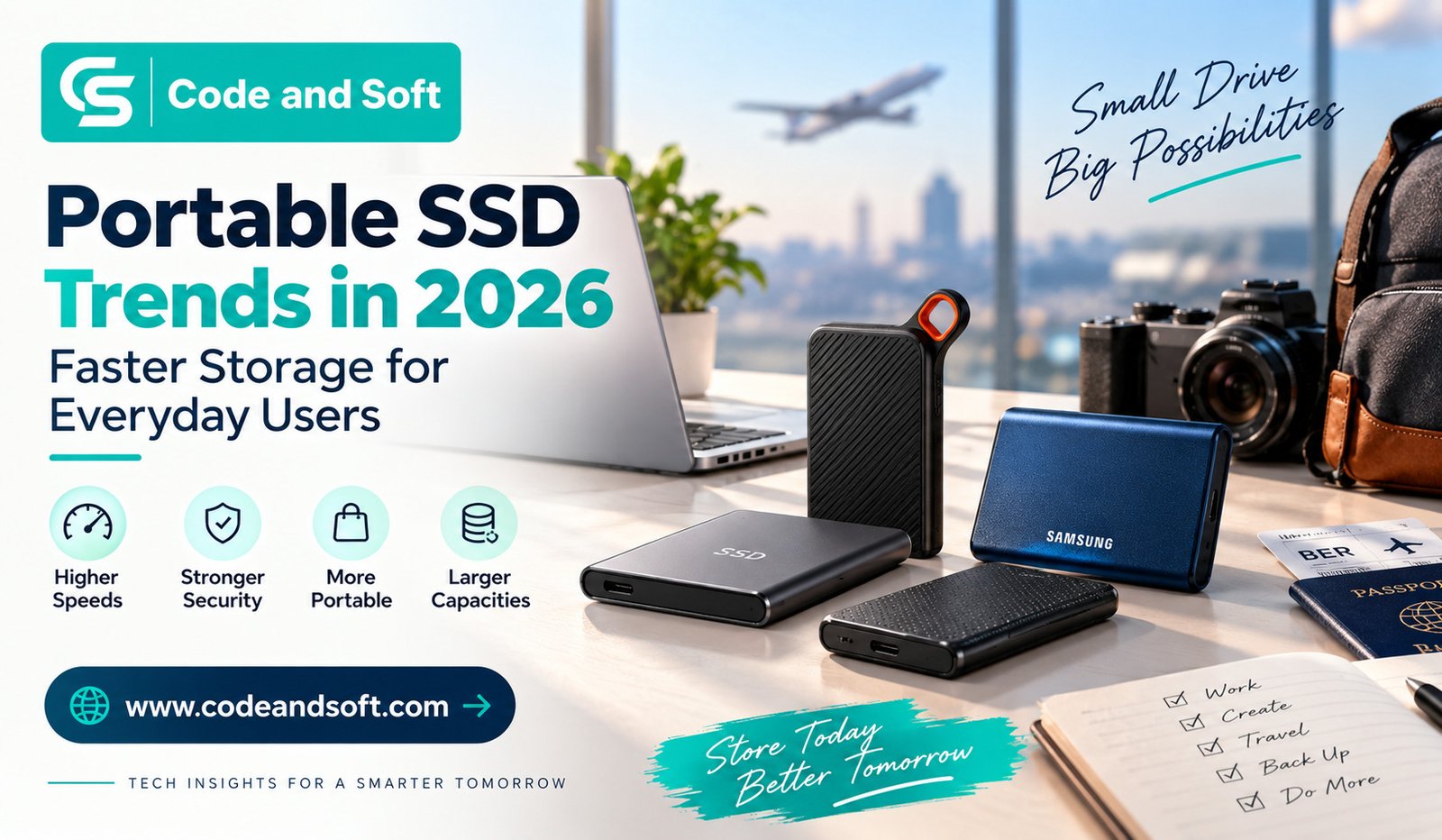

Portable storage has changed dramatically in just a few years. What once felt like a premium accessory for photographers, video editors, and professionals is now becoming a practical tool for everyday users. Whether you regularly move large files between your laptop and phone, keep backups of important documents, store games, or work with high-resolution photos and videos, a portable SSD can make your digital life much easier.
In 2026, the biggest change is not simply that portable SSDs are becoming faster. You are seeing improvements across connectivity, capacity, size, durability, smartphone compatibility, and everyday usability.
The latest generation is also pushing USB4 into the portable-storage market. Samsung, for example, has introduced its P9 and P7 portable SSDs with USB4, with the P9 reaching up to 4,000MB/s read speeds and capacities up to 8TB.
So, what should you expect from portable storage this year? Let’s look at the major Portable SSD Trends in 2026 and how they could affect the way you store and move your data.
1. USB4 Is Becoming a Major Portable SSD Trend
For years, 10Gbps and 20Gbps USB connections were common choices for external SSDs. In 2026, USB4 is becoming much more important, particularly in premium portable SSDs and newer computers.
The reason is simple: faster interfaces allow SSD manufacturers to push considerably higher transfer speeds.
Samsung’s new P9, for example, is rated for read speeds of up to 4,000MB/s and write speeds of up to 3,800MB/s. That is a substantial step above many familiar USB 3.2-based portable SSDs.
For you, this means transferring large files can take significantly less time.
Imagine moving a folder containing hundreds of gigabytes of video footage. With an older external drive, you may spend a considerable amount of time waiting. With a high-speed USB4 SSD and a compatible computer, that same workflow can become much quicker.
However, there is an important catch: your computer’s port matters.
Buying a USB4 SSD does not automatically mean you will get its maximum advertised speed. The host device, cable, interface and workload all influence actual performance. Storage testing in 2026 continues to show that interface and thermal limitations can prevent users from reaching the headline numbers printed on the box.
2. Portable SSDs Are Getting Smaller and Thinner
Speed isn’t the only area receiving attention. Manufacturers are also trying to make portable SSDs easier to carry.
The latest designs show just how small external storage can become. Lexar’s upcoming Muse Ultra-Slim Portable SSD, announced in 2026, measures only around 3.8mm at its thickest point. It is designed around a very thin PCB and high-density NAND storage.
For you, this matters if you travel frequently or carry your SSD alongside a laptop, tablet or smartphone.
A smaller SSD can easily fit into:
- A laptop sleeve
- A camera bag
- A backpack pocket
- A travel pouch
- Even a smartphone accessory setup
This trend is likely to continue because people don’t want their external storage to feel like another bulky computer accessory.
The goal is increasingly simple: more storage without more weight.
3. Direct Smartphone Storage Is Becoming More Useful
One of the more interesting Portable SSD Trends in 2026 is the closer relationship between SSDs and smartphones.
Modern smartphones can capture enormous amounts of data. High-resolution photography and advanced video recording can consume storage quickly, particularly when recording professional-quality footage.
Instead of filling your phone’s internal storage, you can connect a compatible portable SSD and save files directly to external storage.
This is particularly useful if you use your smartphone as a camera.
New SSD designs are also experimenting with magnetic mounting systems. Lexar’s Muse, for example, is designed with a magnetic sleeve that allows the drive to be attached to a smartphone during recording.
That gives you a more practical setup for long video sessions.
For example, if you record a large amount of 4K video, external storage can help you avoid constantly stopping to delete older footage.
4. 4K, 8K and Higher-Resolution Content Are Driving Demand
You don’t need to be a professional filmmaker to notice how quickly file sizes are increasing.
A photo from a modern smartphone can be surprisingly large. A few minutes of high-quality video can consume several gigabytes. RAW photography, 4K video, 8K footage and other high-resolution formats create an even greater need for storage.
This is one reason portable SSD manufacturers are focusing heavily on speed and capacity.
Samsung’s P9, for instance, is designed for demanding workflows including direct 12K video recording and is available in capacities reaching 8TB.
You may not need 8TB yourself, but the trend is important. Higher-capacity portable SSDs are increasingly becoming practical options for users who maintain large media libraries.
For everyday users, 1TB and 2TB drives can offer a comfortable balance between portability, capacity and cost.
If you regularly work with videos, games or large creative projects, moving toward 4TB or more can make sense.
5. Portable SSDs Are Becoming More Relevant for Gaming
Games are another major reason external storage continues to evolve.
Modern PC and console games can occupy huge amounts of storage. Installing several large titles can quickly consume the available space on your internal SSD.
A portable SSD gives you another option.
You can use it to store games, move your gaming library between compatible systems, or keep additional files without immediately replacing your internal drive.
Faster external interfaces also make portable SSDs more attractive to gamers. USB4-based drives are now targeting performance levels that were previously associated with more specialized storage hardware.
Still, you should check whether your particular gaming platform supports the external drive for the way you intend to use it. Compatibility and supported transfer speeds can vary.
6. Durability Is Becoming a Bigger Selling Point
Portability creates a problem: you are more likely to drop, bump or expose an external drive to challenging conditions.
That’s why manufacturers are increasingly focusing on rugged designs.
Modern portable SSDs can include features such as:
- Shock resistance
- Drop protection
- Vibration resistance
- Protective metal or rubberized bodies
- Compact designs for travel
Samsung’s new P7 and P9, for example, have undergone durability testing including a 2-meter drop test.
If you carry an SSD in your backpack every day, durability can be just as important as raw speed.
After all, an SSD that delivers impressive benchmark results isn’t particularly useful if it gets damaged during your commute.
7. Heat Management Will Matter More as SSDs Get Faster
There’s an unavoidable challenge behind the push toward faster portable SSDs: heat.
As transfer speeds increase, controllers and NAND storage can generate more heat. If temperatures become too high, the SSD may reduce its performance to control heat.
This means that the fastest SSD on paper isn’t necessarily the fastest drive for every real-world situation.
If you regularly transfer hundreds of gigabytes, edit video directly from an external SSD or perform long write operations, thermal performance becomes especially important.
For occasional file transfers, you may never notice the difference.
This is why you should look beyond the advertised sequential read speed when choosing a portable SSD. The enclosure, controller, sustained performance and cooling design can all influence your experience.
8. AI Is Increasing Storage Requirements
AI is another factor influencing storage demand in 2026.
You don’t necessarily need to run a large AI model locally to feel the impact. AI-generated images, videos, datasets, applications and creative projects can all create additional files.
At the professional end, AI workloads are also contributing to increased demand for memory and storage infrastructure. Consumer SSD pricing has remained under pressure amid elevated demand, particularly as storage manufacturers serve data-center and AI-related requirements.
For you, this means storage planning is becoming more important.
If your laptop has limited internal capacity, a portable SSD can provide a convenient way to keep large files without constantly deleting projects.
9. USB4 and Thunderbolt 5 Will Push Performance Further
Another important development is the evolution of high-speed connectivity.
USB4 Version 2.0 and Thunderbolt 5 are pushing external connectivity beyond the speeds that many users have traditionally associated with USB storage. Premium computers are increasingly adopting these technologies, opening the door to faster external storage and other high-bandwidth accessories.
You don’t necessarily need to rush out and buy the fastest interface available.
Instead, think about your actual workflow.
If you mostly move Word documents, PDFs and photos, a mainstream 10Gbps SSD may already feel extremely fast.
If you edit large video files or move hundreds of gigabytes regularly, a faster USB4 or Thunderbolt-compatible SSD can make more sense.
10. SSD Prices May Not Fall as Quickly as You Expect
One thing you should keep in mind in 2026 is pricing.
Although storage technology continues to improve, SSD prices are being influenced by broader NAND supply and demand conditions. Recent market coverage has noted that consumer SSD pricing remains elevated compared with previous years.
That makes it more important to buy according to your actual needs.
You don’t necessarily need the newest 4,000MB/s drive if your laptop only supports a slower connection.
Likewise, buying a very large 8TB SSD simply because it is available may not be worthwhile if you only need to back up photos and documents.
For many users, 1TB or 2TB remains a practical sweet spot.
What Should You Look for in a Portable SSD in 2026?
When you’re choosing a portable SSD, don’t focus on one specification.
Consider these factors together:
| Feature | What You Should Consider |
| Capacity | 1TB–2TB for general use; 4TB+ for large media libraries |
| Interface | USB-C, USB 3.2, USB4 or Thunderbolt depending on your device |
| Speed | Match the SSD’s speed to your computer’s port |
| Durability | Useful if you travel frequently |
| Size | Smaller drives are easier to carry |
| Heat management | Important for long transfers |
| Compatibility | Check PC, Mac, smartphone or console support |
| Security | Consider encryption if storing sensitive files |
The most expensive SSD isn’t automatically the right one for you.
Your computer, phone and workload should determine what you buy.
The Future of Portable SSDs Is Fast, Small and Flexible
The biggest takeaway from the Portable SSD Trends in 2026 is that external storage is becoming less of a simple backup accessory and more of an everyday computing tool.
You are seeing faster USB4 connectivity, slimmer designs, larger capacities, improved durability and stronger smartphone integration. At the high end, portable SSDs are reaching performance levels suitable for demanding video workflows, while mainstream models continue to provide a convenient way to expand laptop and desktop storage.
At the same time, you shouldn’t get distracted by headline speeds alone.
A 4,000MB/s SSD sounds impressive, but if your laptop cannot take advantage of that bandwidth, you’re paying for performance you may never experience.
For everyday use, a reliable 1TB or 2TB portable SSD with a fast USB-C connection may be more than enough. If you’re a photographer, content creator, gamer or professional handling huge files, moving toward USB4 and higher capacities can provide a much more noticeable advantage.