
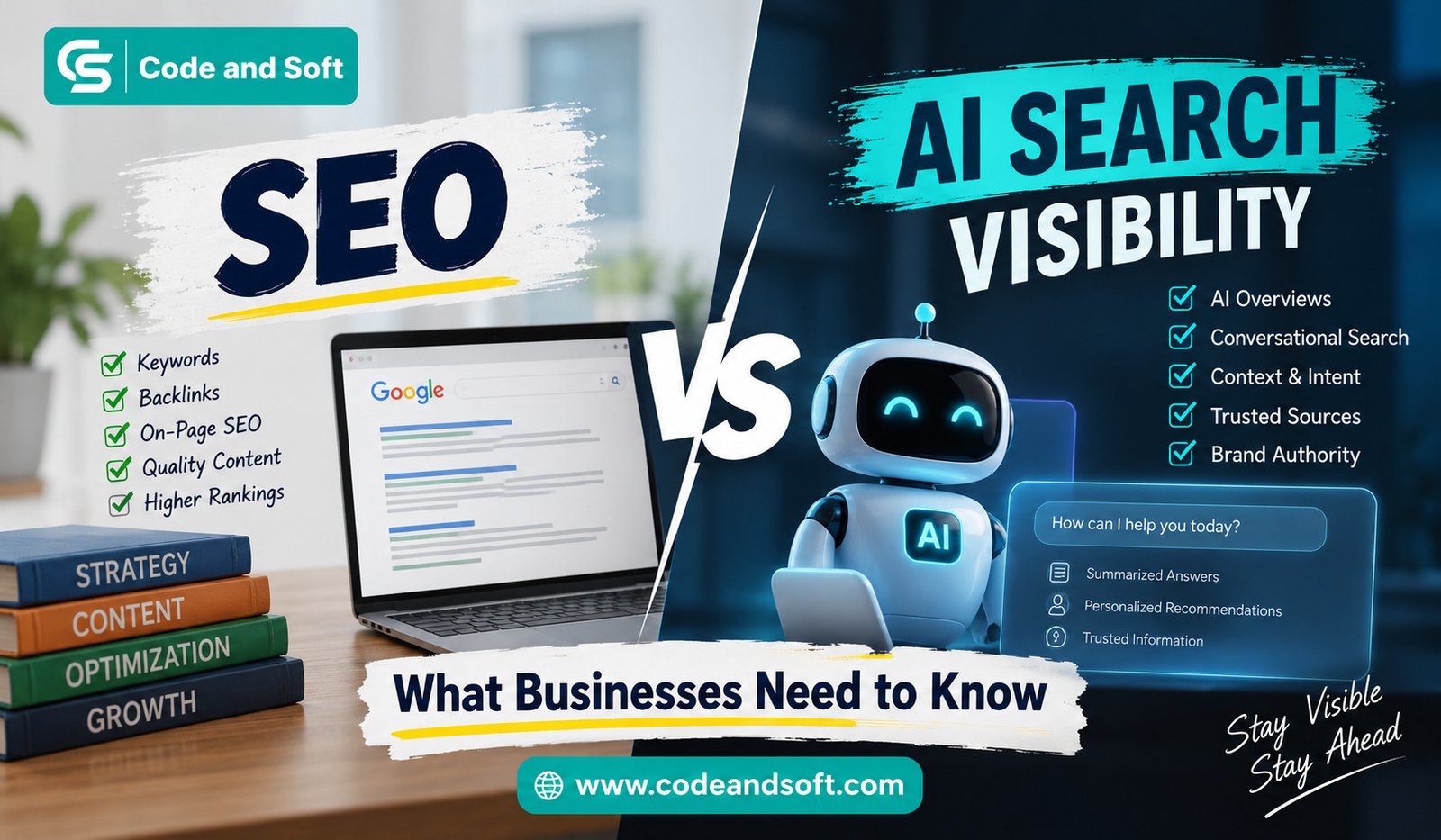

Search is changing faster than many businesses expected. For years, you probably focused on getting your website onto the first page of Google, improving rankings, earning backlinks, and choosing the right keywords. Those strategies still matter, but the way people discover information online is no longer limited to traditional search engines.
Today, users can ask AI tools questions and receive direct, conversational answers instead of a list of website links. They may never visit a search results page at all. If your business is not mentioned, recommended, or referenced in those AI-generated answers, you could be missing potential customers even if your website has strong traditional search rankings.
That is where the discussion around SEO vs AI Search Visibility becomes important.
Traditional SEO helps you become visible in search engine results. AI search visibility focuses on whether your business, products, services, expertise, or content can be discovered and represented accurately in AI-generated responses.
For you as a business owner or marketer, the goal shouldn’t be to choose one over the other. You need to understand how both approaches work together.
What Is Traditional SEO?
Search engine optimization, or SEO, is the process of improving your website so search engines can understand, index, and rank your content.
When you optimize a page for a specific search query, you are essentially helping search engines determine that your content is useful for someone looking for that information.
Your traditional SEO strategy may include:
- Keyword research
- On-page optimization
- Technical SEO
- Internal linking
- Backlink building
- Mobile optimization
- Page speed improvements
- Creating helpful content
- Optimizing title tags and meta descriptions
- Building topical authority
For example, if you sell accounting software, you might create a detailed article targeting searches such as “accounting software for small businesses.” If your page provides a useful answer and your website has sufficient authority, it may eventually appear prominently in Google’s organic results.
The basic objective is straightforward: help your website appear when someone searches for something related to your business.
But AI-powered search is changing what happens after that query is entered.
What Is AI Search Visibility?
AI search visibility refers to how easily your business or content can be discovered, understood, and mentioned by AI-powered search and answer systems.
Instead of simply displaying ten blue links, AI systems can analyze information from multiple sources and generate a direct response.
Imagine someone asks:
“Which project management tools are suitable for a growing marketing agency?”
Rather than receiving a traditional list of search results, the user might get a summarized answer mentioning several software companies, explaining their features and comparing their strengths.
If your company is absent from that answer, your traditional Google ranking may not be enough to capture that user’s attention.
AI search visibility therefore looks beyond rankings.
You want AI systems to understand:
- What your business does
- Who your products or services are for
- What makes your brand different
- Which topics you have expertise in
- How trustworthy your information is
- How other credible sources describe your business
This doesn’t mean you can simply “optimize for AI” with a secret trick. AI systems rely on information, context, relevance, credibility, and signals from across the web.
SEO vs AI Search Visibility: The Key Difference
The easiest way to understand SEO vs AI Search Visibility is to look at what each one is trying to achieve.
Traditional SEO primarily focuses on ranking your web pages for search queries.
AI search visibility focuses on getting your brand or information represented within AI-generated answers.
There is some overlap, but they aren’t identical.
For example, traditional SEO may ask:
“How can I get this article to rank for ‘best CRM software for startups’?”
AI search visibility asks a slightly different question:
“If someone asks an AI tool to recommend CRM software for startups, is my company likely to be considered and accurately described?”
That difference is becoming increasingly important.
Why Traditional SEO Still Matters
With all the attention around AI search, you might think traditional SEO is becoming irrelevant. That would be a mistake.
Search engines still generate enormous amounts of traffic, and strong SEO can also support your visibility in AI-driven environments.
When you publish useful, well-structured, authoritative content, you give search engines and AI systems more information about your expertise.
Your website can become a reliable source covering a particular subject in depth.
For example, instead of publishing dozens of shallow articles about digital marketing, you could build a comprehensive collection covering technical SEO, content strategy, local search, analytics, link building, and search trends.
Over time, this creates stronger topical signals.
So, rather than abandoning SEO, you should think of it as the foundation of your broader search visibility strategy.
How AI Search Changes Content Strategy
Traditional SEO often encourages you to think about keywords.
AI search encourages you to think about questions, context, entities, and complete answers.
People don’t always phrase questions the way they type traditional search queries.
Someone might search Google for:
“CRM software pricing.”
But when using an AI assistant, they could ask:
“I’m running a 20-person sales team. Which CRM should I consider if I need automation, reporting, and affordable pricing?”
That is a much more detailed question.
Your content needs to address the underlying problem rather than simply repeat a keyword.
You should create content that answers real customer questions, explains complicated subjects clearly, compares alternatives fairly, and provides enough context for your expertise to be understood.
Build Content That AI Can Understand
If you want stronger AI search visibility, start by making your content easy for both people and machines to understand.
Clear structure matters.
Use descriptive headings, short paragraphs, bullet points, tables where appropriate, definitions, examples, and straightforward explanations.
Don’t hide the important information behind vague marketing language.
Instead of saying:
“Our innovative platform delivers next-generation solutions for modern businesses.”
Explain what the platform actually does.
For example:
“You can use the platform to schedule social media posts, monitor engagement, manage multiple accounts, and analyze campaign performance from one dashboard.”
The second version provides much more useful information.
When your content clearly communicates what you offer, it becomes easier for search systems and AI models to interpret your business.
Develop Real Expertise, Not Just More Content
One of the biggest mistakes you can make is assuming that publishing more articles automatically improves visibility.
It doesn’t.
You could publish 100 generic posts and still struggle to establish authority.
Instead, focus on demonstrating genuine knowledge.
If you operate a cybersecurity company, create useful resources around cybersecurity challenges your customers actually face. Explain threats, prevention methods, implementation considerations, and common mistakes.
Share original insights whenever possible.
Case studies, research, expert commentary, first-hand experiences, data, examples, and detailed guides can make your content considerably more useful than generic articles that simply repeat information already available elsewhere.
Your goal should be to become a source worth referencing.
Don’t Ignore Your Brand’s Online Reputation
AI search visibility isn’t only about what you publish on your own website.
Information about your business exists across the internet.
Industry publications, review websites, business directories, social platforms, forums, partner websites, news articles, and other third-party sources can all contribute to how your business is understood online.
That means you should pay attention to your broader digital presence.
Make sure your business information is consistent. Keep important profiles updated. Encourage genuine customer reviews. Look for legitimate opportunities to earn mentions from respected publications and industry websites.
You cannot completely control what the internet says about your company, but you can make sure accurate and useful information is available.
Create Content Around Customer Questions
One practical way to prepare for AI-driven search is to stop thinking only in terms of keywords and start thinking about customer conversations.
Ask yourself:
- What questions do customers ask before buying?
- What problems are they trying to solve?
- What comparisons do they make?
- What objections stop them from purchasing?
- What mistakes do they commonly make?
- What information do they need after buying?
Then build content around those questions.
For example, if you sell accounting software, don’t limit your content to articles such as “Accounting Software Features.”
You could create resources covering:
- How to choose accounting software for a small business
- Accounting software vs spreadsheets
- Questions to ask before switching accounting platforms
- How much accounting software actually costs
- Common accounting automation mistakes
- How to migrate financial data safely
This gives your website broader contextual coverage and creates more opportunities to demonstrate expertise.
SEO and AI Search Visibility Work Together
The debate around SEO vs AI Search Visibility can make the two strategies sound like competing approaches.
In reality, they are increasingly connected.
Your SEO work helps search systems discover and understand your website. Your content provides information that can potentially be used when systems generate answers. Your backlinks, brand mentions, reviews, and other online signals can contribute to how your business is perceived.
At the same time, AI search pushes you to improve the quality of your content.
Instead of obsessing over one keyword, you need to think about the entire topic.
Instead of writing for search engines alone, you need to create genuinely useful resources.
Instead of measuring success only through rankings, you should consider broader indicators of visibility and brand discovery.
What Should You Measure?
Traditional SEO gives you familiar metrics such as:
- Organic traffic
- Keyword rankings
- Click-through rate
- Backlinks
- Organic conversions
- Indexed pages
AI search visibility is more difficult to measure because AI-generated answers don’t always provide the same analytics available through traditional search platforms.
You can still monitor brand mentions, referral traffic, visibility in AI-generated responses through appropriate testing, branded search growth, and the quality of third-party references to your business.
The important thing is not to replace every SEO metric overnight.
Instead, expand your measurement approach.
You want to understand not only where you rank, but also how your brand is discovered and represented.
How You Can Prepare Your Business
You don’t need to completely rebuild your marketing strategy to adapt.
Start with the fundamentals.
Audit your existing website and remove outdated or inaccurate information. Strengthen important service and product pages. Create detailed content around customer questions. Improve internal linking so related topics connect naturally.
Then look beyond your website.
Build legitimate authority through useful partnerships, digital PR, expert contributions, reviews, and industry mentions. Keep your business information consistent across important platforms.
Most importantly, avoid chasing shortcuts.
There is no reliable formula that guarantees an AI system will mention your business. Be skeptical of anyone promising instant AI rankings or a guaranteed position inside AI-generated answers.
Your strongest long-term strategy is still to provide information that is genuinely useful, accurate, trustworthy, and easy to understand.
The Future of Search Is Broader Than Rankings
The biggest lesson from SEO vs AI Search Visibility is that search visibility is becoming more complicated.
You are no longer optimizing only for a search results page.
Your potential customer might discover you through a traditional Google result, an AI-generated answer, a recommendation, a review, a social post, a community discussion, or a combination of several sources.
That means your online presence needs to tell a consistent story.
Your website should clearly explain what you do. Your content should demonstrate expertise. Your third-party presence should reinforce your credibility. And your overall digital footprint should make it easy for both people and modern search systems to understand your business.
Traditional SEO isn’t disappearing. It’s evolving alongside the way people search.
If you continue building high-quality content, earning genuine authority, answering customer questions, and making your website useful, you give your business a stronger chance of being visible wherever search is heading next.
The goal isn’t simply to rank higher.
The goal is to become a business that people—and the systems helping them find information—can easily understand, trust, and choose.