
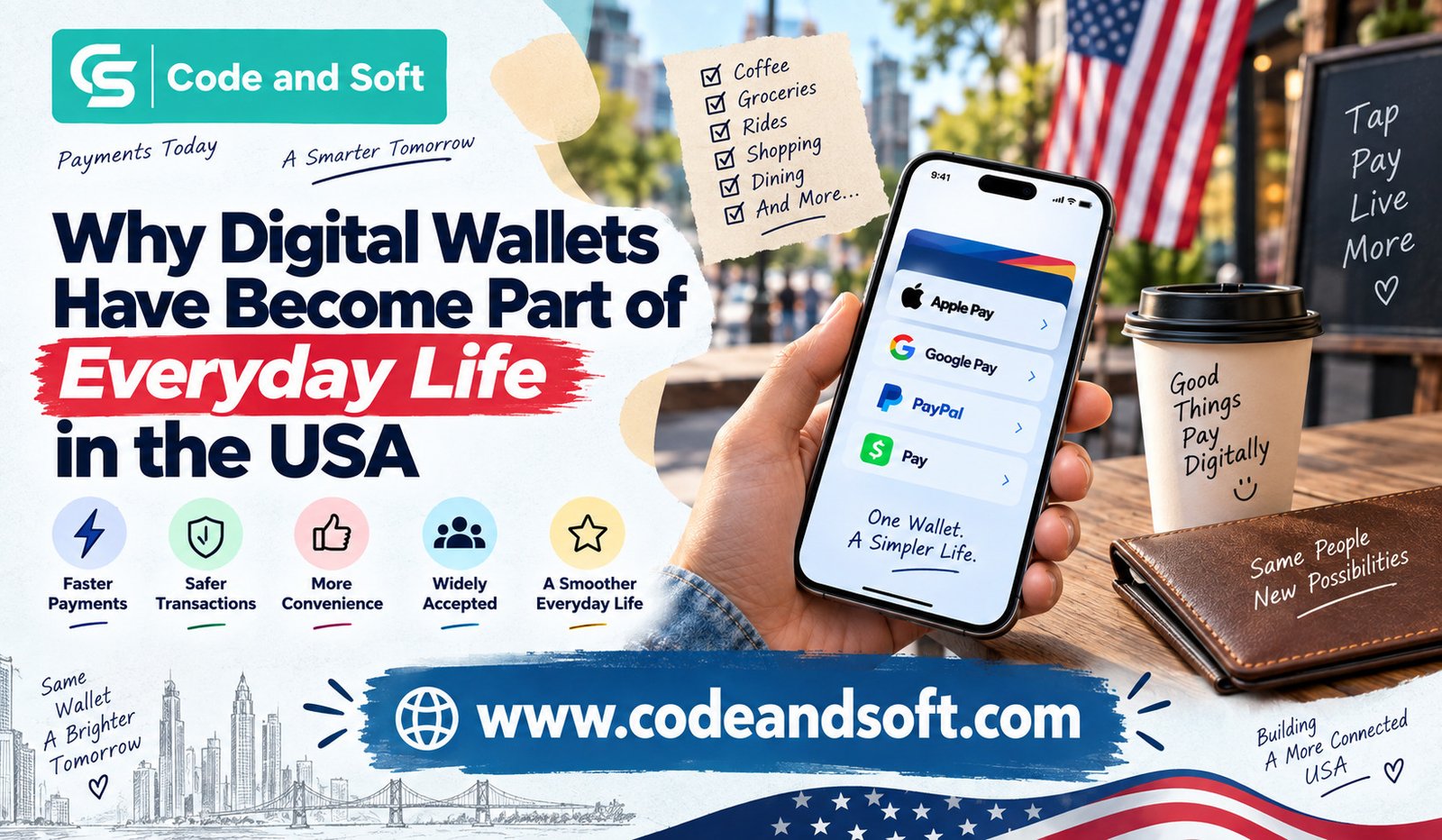

Imagine leaving your house with your phone, keys and perhaps your ID—but without your physical wallet. For many people in the United States, that no longer feels particularly unusual. Your phone can hold payment cards, send money to friends, pay bills, store tickets and even help you manage everyday financial tasks.
This shift explains why Digital Wallets Use In USA has become such an important part of modern consumer behavior. Digital wallets are no longer something you use only when shopping online or trying a new payment feature. You can now use them for your morning coffee, splitting a restaurant bill, paying a freelancer, shopping online or sending money to a family member.
The Federal Reserve’s latest consumer payment research shows that Americans made an average of 47 payments per month in 2026, while credit and debit cards continued to account for about two-thirds of payments. At the same time, mobile and digital payment options have become deeply integrated into everyday financial habits.
So, why have digital wallets become so normal in American life?
Convenience Is the Biggest Reason
The simplest explanation is convenience.
Think about the number of things you already carry on your smartphone. Your phone has your messages, maps, photos, boarding passes, shopping apps and banking services. Adding payment capabilities to that same device makes everyday transactions much easier.
Instead of searching through your bag for a physical card, you can unlock your phone and pay. At a compatible checkout terminal, you may only need to hold your phone or smartwatch near the reader.
That small change can make a surprisingly big difference.
You are also less dependent on remembering which physical card you brought with you. Your digital wallet can store multiple cards, allowing you to choose the appropriate payment method at checkout.
Research from J.D. Power found that ease of use is a major factor behind digital wallet adoption, with almost half of U.S. consumers surveyed saying they had used a digital wallet during the previous 90 days in its 2024 study.
For you, the attraction is simple: fewer steps between deciding to buy something and actually paying for it.
Apple Pay Makes Phone Payments Feel Natural
If you use an iPhone, Apple Pay can turn your smartphone or Apple Watch into a convenient payment tool.
You can add eligible debit and credit cards to your device and use them at participating stores, inside apps and on websites. For many iPhone users, paying becomes an extension of something they already do hundreds of times a day—using their phone.
Apple Pay has also benefited from the popularity of the iPhone in the U.S. The Consumer Financial Protection Bureau previously reported that roughly three in four U.S. iPhone users had activated Apple Pay, illustrating how closely mobile hardware and digital payments have become connected.
This is one reason Digital Wallets Use In USA is not simply about replacing cash. It is about bringing payment into an environment where you already spend much of your time.
Cash App and Zelle Fit Into Everyday Money Transfers
Digital wallets are not limited to shopping at stores.
You probably have situations where you need to send money to another person. Maybe you are splitting dinner with friends, paying someone for a small service, contributing to a group gift or sending money to a family member.
This is where services such as Cash App and Zelle become useful.
Cash App has developed beyond simple person-to-person payments, offering a broader collection of financial features. Zelle, meanwhile, is closely connected with participating banks and credit unions, making it particularly convenient when you want to send money directly between bank accounts.
The popularity of these services shows how digital payments have moved beyond the checkout counter. You can now manage many informal financial interactions from your phone.
In fact, S&P Global found that 83% of U.S. internet adults had used a digital financial service app during the previous year in its 2024 research, with consumers often using multiple financial apps rather than relying on just one.
Google Pay Helps Android Users Go Wallet-Free
You do not need an iPhone to experience mobile payments.
For Android users, Google Pay and Google Wallet have helped make digital payments part of the everyday smartphone experience. You can use compatible cards and payment methods for purchases, depending on the retailer, device and service available.
This matters because America’s smartphone market is divided between different ecosystems. Apple Pay may be particularly familiar to iPhone users, while Google’s payment tools provide a similar experience for many Android users.
The result is a competitive digital payment environment where you can choose services based on your phone, bank, preferred apps and spending habits.
And increasingly, merchants are adapting too. Recent retail developments show more American stores adding contactless payment options, making it easier for customers to use services such as Apple Pay and Google Pay at physical checkout.
PayPal and Venmo Make Digital Payments More Social
You may associate PayPal with online shopping, but its role in American digital payments is much broader.
PayPal has been used for online purchases for years, giving consumers a familiar way to pay without repeatedly entering card information. It remains one of the most recognized digital payment platforms in the U.S.
Venmo, also owned by PayPal, has a different personality. It is particularly associated with sending money between friends and managing shared expenses.
You might use Venmo after going out for dinner, paying your share of rent, buying something from someone you know or contributing to a group activity.
That social aspect is important. Digital wallets are not just financial tools anymore. They have become part of how you interact with other people.
Recent research from Morning Consult found that PayPal remains the strongest overall payment-platform brand in the U.S., while Apple Pay, Zelle, Venmo and Cash App have particular strengths in different payment situations.
Online Shopping Has Changed the Way You Pay
Another major reason for the growth of digital wallets is online shopping.
When you shop online, you want the checkout process to be quick. Typing a card number, expiration date, security code and billing address every time can be frustrating.
A digital wallet can reduce that friction.
You can select your preferred payment option, confirm the transaction and complete your purchase without manually entering all your card details.
This is particularly useful when you shop from your smartphone. Instead of switching between apps to find card information, you can often complete the transaction directly through a supported wallet or payment service.
Digital wallets have therefore become closely connected to the broader growth of e-commerce. They make online checkout faster while giving businesses another way to reduce abandoned purchases.
Security Also Plays a Role
Convenience may get you to try a digital wallet, but security can encourage you to keep using it.
Modern mobile payment systems can use features such as device authentication, biometric verification and tokenized payment credentials. In simple terms, the information transmitted during a transaction does not necessarily expose your actual physical card number to the merchant in the same way as handing over a card.
That does not mean digital wallets are completely risk-free. You still need to protect your phone, use strong authentication and be careful about scams, suspicious links and fraudulent payment requests.
However, the combination of convenience and built-in security features has helped make mobile payments more comfortable for many consumers.
Digital Wallets Are Becoming Part of Different Generations’ Lives
You might assume that digital wallets are primarily a younger person’s habit. There is some truth to that, but the picture is changing.
Federal Reserve research found that mobile phone payments increased across age groups, while younger consumers were especially likely to use their phones for payments. In 2024, consumers averaged 11 mobile-phone payments per month, and adults aged 18–24 used mobile phones for 45% of their payments.
At the same time, traditional payment methods have not disappeared.
Cash remains important in the U.S., and credit and debit cards continue to dominate many transactions. The latest Federal Reserve data shows that consumers are not necessarily choosing one payment method exclusively. Instead, you may use different options depending on the situation.
You might use Apple Pay for coffee, a credit card for a large purchase, Zelle to pay a friend and cash at a local business.
That flexibility is one of the biggest characteristics of modern American payments.
And More: The Digital Wallet Ecosystem Keeps Growing
Apple Pay, Cash App, Zelle, Google Pay, PayPal and Venmo are only part of the broader digital payment ecosystem.
You may also encounter Samsung Wallet, banking apps, retailer-specific payment systems, buy-now-pay-later services and other financial technology platforms.
The important change is that you no longer have to think of your wallet as a physical object.
Your financial life can now be spread across several apps that work together.
One app might handle everyday purchases. Another may help you send money to friends. Your banking app may manage bills and account balances. A separate service may handle online shopping.
This is why Digital Wallets Use In USA continues to grow as a broader consumer habit rather than simply a trend associated with one particular app.
The Future of Everyday Payments Is Likely to Be Even More Digital
Digital wallets have become popular because they solve a very ordinary problem: how to make payments with less effort.
You already carry your phone almost everywhere. When that phone can also act as your payment card, bank interface and money-transfer tool, it makes sense to use it for everyday financial tasks.
Still, the American payment landscape is unlikely to become completely cashless or cardless overnight. The Federal Reserve continues to find that cash remains an important payment option and backup for consumers.
Instead, you are likely to see more choice.
You may pay with a phone at one store, a physical card at another and cash somewhere else. What matters is that digital wallets have earned a permanent place among those choices.
And that is perhaps the biggest reason they have become part of everyday life in the USA: they do not require you to completely change how you manage money. They simply make many of the things you already do—shopping, paying, sharing and transferring money—easier to complete from the device you already carry.