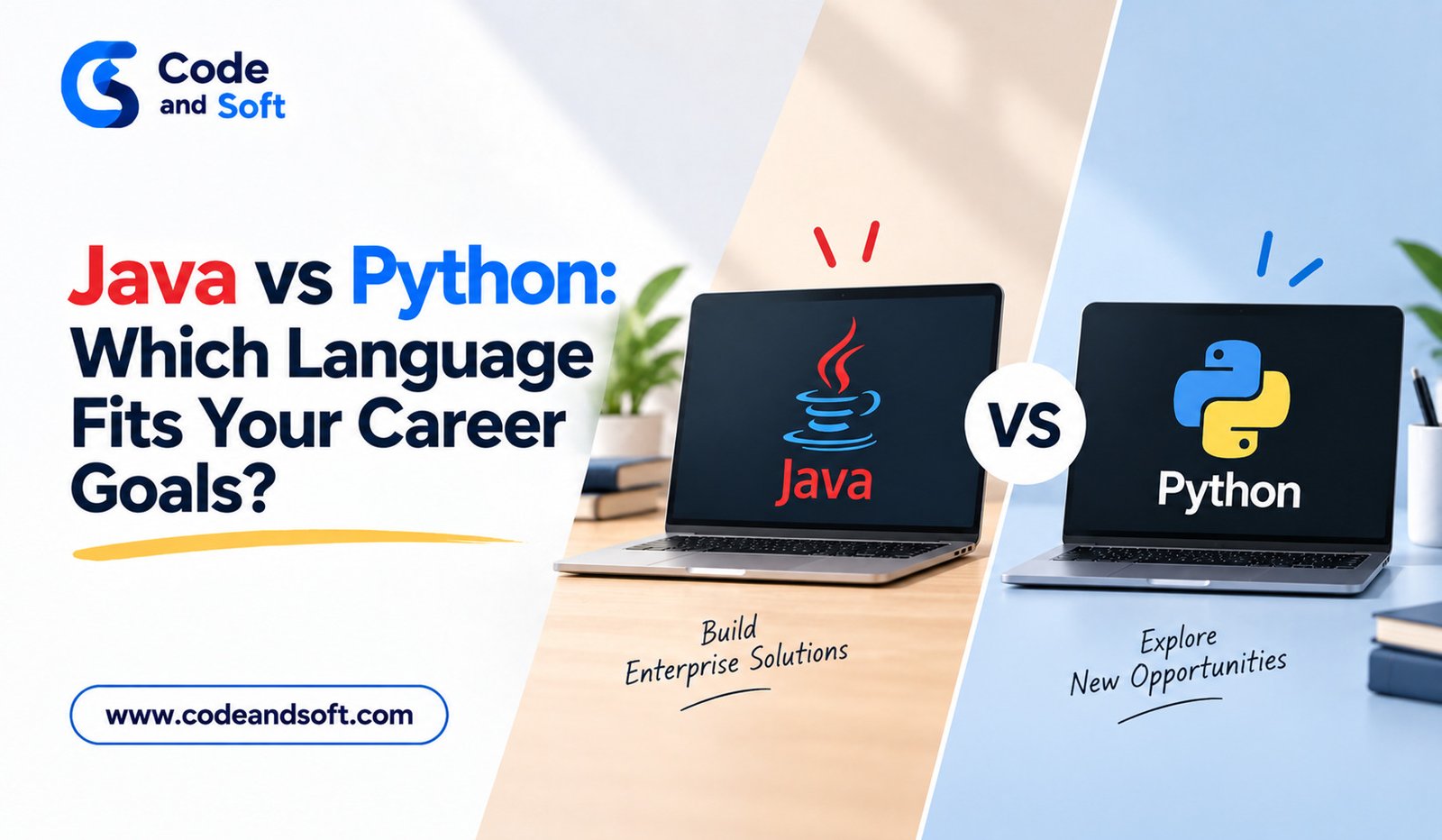
Choosing a programming language can be one of the biggest decisions for a student or beginner entering the software industry. Java and Python are both highly useful languages, but they are often used for different types of projects and career paths. Instead of asking which language is universally better, it is more useful to ask which one matches your goals.
Java has a long history in enterprise software, backend development, financial systems, large business applications, and Android-related development. Python is known for its approachable syntax and strong presence in data science, artificial intelligence, automation, web development, and scripting.
Both can lead to successful technology careers. The better choice depends on what you want to build, how you prefer to learn, and which area of software development interests you most.
Understanding Java and Python
Java is a general-purpose, object-oriented programming language widely used for large and structured software applications. Its syntax is more formal than Python’s, and developers typically work with explicit data types and organized program structures.
Python is also a general-purpose language, but it is known for having relatively simple and readable syntax. This makes it attractive to beginners and useful for quickly creating scripts, applications, automation tools, and prototypes.
Both languages support multiple programming styles and have extensive ecosystems of libraries and development tools.
Java vs Python for Beginners
For someone writing their first program, Python is often easier to approach.
A basic Python statement can be very short:
print(“Hello, Python!”)
Java generally requires more structure:
public class Main {
public static void main(String[] args) {
System.out.println(“Hello, Java!”);
}
}
The additional structure in Java may initially seem complicated. However, it can teach beginners important concepts about program organization, classes, methods, and application structure.
Python can therefore provide a smoother introduction, while Java can encourage a more structured understanding of software development from the beginning.
Java for Enterprise and Backend Careers
Java can be an excellent option for people interested in enterprise software and backend development.
Large organizations use Java for business applications, financial systems, internal platforms, APIs, transaction-processing systems, and other long-running software.
Java’s ecosystem includes established frameworks and tools for building backend applications. Developers can work with technologies such as Spring and Spring Boot to create APIs and business services.
If your career goal involves becoming a backend developer in a large organization, Java can be a strong language to learn.
Python for Data Science and Artificial Intelligence
Python has a particularly strong position in data-related careers.
People working in data science, machine learning, artificial intelligence, scientific computing, and data analysis frequently use Python because of its extensive collection of specialized libraries and tools.
Python can also be useful for processing datasets, experimenting with models, creating automation scripts, and building prototypes.
If your long-term goal is to work with artificial intelligence, machine learning, data analysis, or scientific applications, Python is usually a natural language to consider.
Web Development With Java and Python
Both languages can be used for web development, although their ecosystems differ.
Java developers can build backend applications and APIs using frameworks such as Spring Boot. These applications are often used in business environments where structured architecture, security, and long-term maintainability are important.
Python developers can use frameworks such as Django and Flask to build web applications and backend services.
The choice may depend on the type of company you want to work for and the type of applications you want to develop.
Java vs Python for Job Opportunities
Both Java and Python offer career opportunities, but the industries and roles can differ.
Java is strongly associated with enterprise application development, backend engineering, financial technology, large business systems, and organizations with established software infrastructure.
Python appears across a wider variety of technical roles, including data analysis, machine learning, automation, backend development, testing, research, and artificial intelligence.
Job titles should therefore be considered alongside the language itself. Learning Java may make sense for someone targeting enterprise backend roles, while Python can be especially useful for people interested in AI, data, or automation.
Performance and Application Requirements
Java and Python also differ in how they approach application execution and performance.
Java applications run through the Java Virtual Machine, which provides a mature runtime environment and various performance optimization capabilities.
Python prioritizes developer productivity and readability. For many applications, this is more important than achieving maximum raw execution speed.
The practical difference depends heavily on the application. A beginner should not choose a language based only on performance comparisons.
Architecture, databases, algorithms, infrastructure, libraries, and application design can all have major effects on real-world performance.
Learning Curve and Programming Concepts
Python’s straightforward syntax can allow beginners to focus on programming logic rather than complicated syntax.
Java introduces more structure early. Students encounter concepts such as classes, objects, data types, methods, interfaces, and access modifiers as they progress.
This can be valuable for people who want to build a strong understanding of object-oriented programming and software architecture.
Python can also teach these concepts, but beginners often start with simpler procedural-style programs before moving into more advanced structures.
Neither learning approach is automatically better. The best option depends on how you learn and what you plan to do with programming knowledge.
Java and Python for Automation
Both languages can be used for automation.
Python is particularly popular for small scripts and automation tasks because developers can often create useful programs with relatively little code.
For example, Python can be used to process files, manipulate data, automate repetitive tasks, interact with APIs, and perform system-related operations.
Java can also automate business processes and build larger applications, especially where automation is part of an enterprise platform.
If your main interest is quick personal or business automation, Python may feel more convenient. For large backend systems that include automated workflows, Java can still be highly relevant.
Which Language Is Better for Mobile Development?
Java has a long history in Android development and remains relevant to understanding Android’s programming ecosystem, although modern Android development also heavily involves Kotlin.
Python is not generally the first choice for mainstream mobile application development.
Therefore, if mobile software interests you, Java may provide more relevant foundations than Python, although you should also consider Kotlin when planning a modern Android career.
Which Language Is Better for Freelancing?
Python can be attractive for freelancers because it can be used for many smaller projects, including automation scripts, data processing, web applications, API integrations, and customized tools.
Java can also provide freelance opportunities, particularly for backend applications, enterprise systems, maintenance work, and API development.
Your freelancing success, however, depends on more than the programming language. Communication skills, problem-solving ability, portfolio quality, reliability, and understanding of client requirements are equally important.
Should You Learn Java or Python First?
Your career goal should guide the decision.
Choose Python if you are especially interested in:
- Artificial intelligence and machine learning
- Data science and analytics
- Automation and scripting
- Scientific computing
- Rapid application development
Choose Java if you are especially interested in:
- Enterprise software
- Backend development
- Large business applications
- Financial technology
- Structured object-oriented programming
- Long-term corporate software systems
If you are still unsure, Python can provide a gentle introduction to programming, while Java can give you a strong foundation in structured and object-oriented development.
Can You Learn Both?
Absolutely.
Learning one language does not prevent you from learning another. In fact, understanding both Java and Python can make a developer more versatile.
Once you understand variables, conditions, loops, functions, data structures, object-oriented programming, and debugging in one language, many programming concepts become easier to recognize elsewhere.
A practical approach is to learn one language deeply rather than trying to study several languages simultaneously.
For example, you could start with Python to understand programming fundamentals and later learn Java for backend or enterprise development. Alternatively, you could begin with Java if your academic program or career target already focuses on it.
What Employers Really Look For
A programming language is only one part of becoming a professional developer.
Employers also look for problem-solving ability, programming fundamentals, database knowledge, version control skills, debugging experience, communication, and the ability to build and maintain real projects.
Someone who understands Python deeply and can build useful applications may be more employable than someone who knows five languages only at a basic level.
The same is true for Java.
Building projects is therefore an important part of your learning journey. A portfolio can demonstrate that you know how to turn programming concepts into practical solutions.
Final Thoughts
Java and Python are both strong choices for a software development career, but they serve different areas particularly well.
Python stands out for its readable syntax, rapid development capabilities, automation uses, and strong connection with artificial intelligence, machine learning, and data science.
Java remains an important choice for enterprise applications, backend systems, structured software development, and large-scale business platforms.
The right language is ultimately the one that supports your career direction. Instead of spending too much time trying to identify a universal winner, choose a language, learn its fundamentals properly, build projects, and develop strong problem-solving skills.
Once you have a solid programming foundation, learning a second language becomes much easier. The goal is not simply to know Java or Python—it is to become a developer who can understand problems, design solutions, write reliable code, and continue learning as technology changes.