Modern software applications rarely perform only one task at a time. A web application may process user requests while communicating with a database, an e-commerce platform may handle multiple orders simultaneously, and a media application may download files while playing content. Java multithreading helps developers build applications that can manage such activities more efficiently.
Java multithreading is the process of running multiple threads within a program. A thread represents an independent path of execution. By dividing work into separate threads, an application can perform multiple activities concurrently instead of waiting for one operation to completely finish before starting another.
Understanding where multithreading becomes useful is more important than simply learning how to create a thread. Real applications require careful decisions about concurrency, shared data, performance, and resource management.
What Is Multithreading in Java?
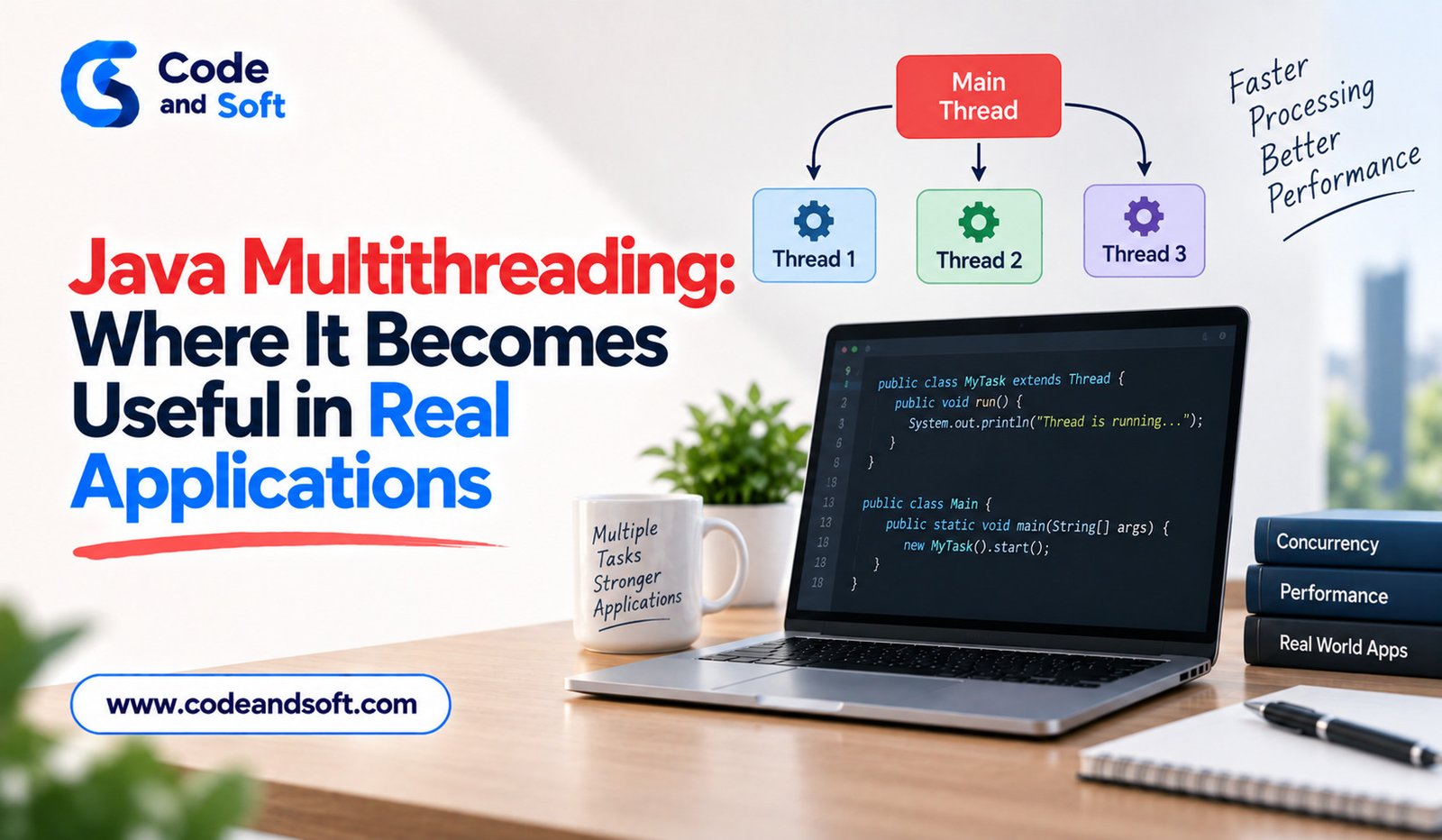
A Java program starts with at least one execution path, commonly known as the main thread. Developers can create additional threads when different tasks need to execute concurrently.
A simple example can be created using the Thread class:
class MessageTask extends Thread {
@Override
public void run() {
System.out.println(“Task is running in a separate thread.”);
}
}
public class Main {
public static void main(String[] args) {
MessageTask task = new MessageTask();
task.start();
System.out.println(“Main thread continues.”);
}
}
The start() method begins a new thread and eventually executes the run() method.
In professional Java development, developers often use higher-level concurrency tools such as executors instead of manually creating large numbers of threads.
Why Applications Need Multiple Threads
Imagine an online application receiving thousands of requests. If every operation had to finish before another could begin, users could experience significant delays.
For example, one request might involve reading data from a database. Another might require an external API call. A third could be generating a report.
These operations may spend considerable time waiting for external resources. Multithreading allows a Java application to make better use of available processing resources while other operations are waiting.
The goal is not simply to create as many threads as possible. Too many threads can increase memory usage and create scheduling overhead. Effective multithreading means using concurrency where it actually improves the application’s behavior.
Multithreading in Web Applications
Java is widely used for backend and enterprise applications. Web servers and Java frameworks commonly handle multiple client requests concurrently.
Suppose an online shopping website receives requests from hundreds of customers. One customer may be viewing products while another is checking an order and another is completing payment.
The backend needs to process these requests without forcing every customer to wait behind previous requests.
A server can use threads or managed thread pools to process independent requests concurrently.
This makes multithreading especially important for applications where many users interact with the system at the same time.
Multithreading for Background Tasks
Some operations do not need to block the main user-facing workflow.
For example, after a customer completes an order, an application may need to generate an invoice, update analytics, send a notification, and perform other background work.
Instead of making the user wait for every secondary operation, suitable tasks can be processed asynchronously.
Java provides the ExecutorService API for managing worker threads.
import java.util.concurrent.ExecutorService;
import java.util.concurrent.Executors;
public class BackgroundTask {
public static void main(String[] args) {
ExecutorService executor =
Executors.newFixedThreadPool(2);
executor.submit(() ->
System.out.println(“Generating invoice…”));
executor.submit(() ->
System.out.println(“Updating analytics…”));
executor.shutdown();
}
}
An executor manages a pool of worker threads, reducing the need for application code to create and manage individual threads repeatedly.
Multithreading in File Processing
Large applications often need to process many files. Processing every file sequentially can take considerable time when the files are independent.
For example, a business application might receive thousands of documents that need to be validated or converted.
Independent files can potentially be processed concurrently, depending on available CPU, storage performance, and application design.
Multithreading can therefore be useful for document processing, log analysis, image operations, data conversion, and similar workloads.
However, developers must consider whether the storage system can handle concurrent access efficiently. Adding threads does not automatically make every file operation faster.
Multithreading in Data Processing
Applications that work with large datasets may divide independent processing tasks into smaller units.
Consider a program that needs to analyze millions of records. Instead of processing every record in a single execution path, the workload may be divided into separate portions.
Each worker can process a different portion, and the results can later be combined.
This approach is particularly useful for CPU-intensive operations when multiple processor cores are available.
Java’s concurrency APIs and parallel processing capabilities can help developers build such systems without manually managing every low-level detail.
Multithreading for Network Operations
Network communication often involves waiting. An application may request information from an external service and spend time waiting for a response.
If the operations are independent, concurrency can help the application perform other useful work during those waiting periods.
For example, a travel application could request hotel availability, flight information, and weather data from different services. Instead of waiting for each response sequentially, suitable concurrent operations can reduce overall waiting time.
This is one reason asynchronous programming and concurrency are important in modern backend systems.
Synchronization and Shared Data
Multithreading introduces an important challenge: multiple threads may access the same data.
Consider a bank account. If two threads attempt to update the same account balance simultaneously, incorrect results could occur if the operations are not properly coordinated.
Java provides synchronization mechanisms to protect shared state.
A simple synchronized method might look like this:
class BankAccount {
private int balance = 1000;
public synchronized void withdraw(int amount) {
if (balance >= amount) {
balance -= amount;
}
}
public int getBalance() {
return balance;
}
}
The synchronized keyword helps ensure that only one thread at a time executes the protected method for the same object.
Developers can also use locks, atomic classes, concurrent collections, and other Java concurrency utilities depending on the problem.
Thread Pools and Efficient Resource Management
Creating a new thread for every small task is generally not a good application design.
Threads consume system resources, and creating too many of them can reduce performance rather than improve it.
Thread pools solve this problem by maintaining a controlled group of reusable worker threads.
Java’s ExecutorService provides several mechanisms for submitting tasks to managed pools.
This approach is common in server-side applications because it allows developers to control concurrency and prevent an application from creating an uncontrolled number of threads.
Multithreading in Real-Time Applications
Applications that need to remain responsive can also benefit from concurrency.
A desktop application, for example, may need to perform a lengthy calculation while keeping its user interface responsive.
Similarly, a monitoring application might continuously collect information while simultaneously displaying updated results.
Separating long-running operations from the main interaction flow can make applications feel faster and more responsive.
Common Problems With Java Multithreading
Multithreading provides significant advantages, but it also introduces complexity.
One common problem is a race condition, where the final result depends on the timing of multiple threads.
Another issue is deadlock. This can happen when two or more threads wait indefinitely for resources locked by one another.
Poorly designed concurrent applications can also experience thread starvation, excessive context switching, memory visibility problems, and unpredictable behavior.
For this reason, developers should avoid using multiple threads simply because concurrency sounds faster. The application should have a clear reason for concurrent execution.
Best Practices for Java Multithreading
Good multithreaded design starts with minimizing shared mutable data. The less information multiple threads need to modify simultaneously, the easier the application becomes to maintain.
Developers should also prefer high-level concurrency utilities when appropriate. Tools such as ExecutorService, concurrent collections, futures, and atomic classes can simplify common concurrency requirements.
Thread pools should be sized according to the type of workload. CPU-heavy tasks and I/O-heavy tasks may require different approaches.
Testing is equally important. Concurrency bugs can be difficult to reproduce because their behavior may depend on timing and system load.
Final Thoughts
Java multithreading becomes useful whenever an application needs to handle multiple activities concurrently, improve responsiveness, process independent workloads, or serve many users efficiently.
Its practical applications range from web servers and background jobs to file processing, network communication, data analysis, and real-time systems.
However, effective multithreading is not about creating more threads. It is about designing tasks carefully, managing resources responsibly, protecting shared data, and choosing the right concurrency tools.
Once developers understand these principles, Java multithreading becomes a powerful technique for building responsive, scalable, and efficient real-world applications.